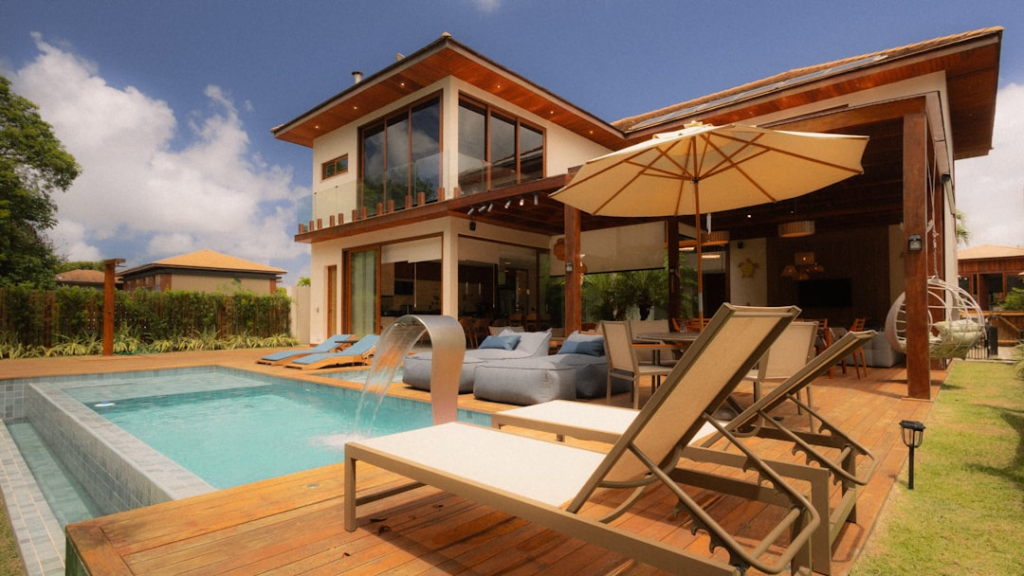
An Ipe deck typically costs $50 to $70 per square foot installed in 2026. That puts a straightforward 12-by-12-foot deck at roughly $7,200 to $10,100 and a 20-by-20-foot deck at about $20,000 to $28,000. Elevated construction, difficult access, custom stairs, premium railings, curved borders and unusually high freight costs can push a project beyond that planning range.
Ipe (pronounced “ee-pay”) is a dense South American hardwood, often sold as Brazilian walnut. It is chosen for its deep brown color, natural durability and long service life. Those advantages come with a high purchase price and more demanding installation than pressure-treated wood, cedar or most composite decking.
The figures below are national planning estimates, not contractor quotes. Local labor, freight, permits, engineering, deck height and railing choices can materially change the final price.
In this Cost Guide
Ipe Deck Cost at a Glance
| Cost component | Typical 2026 range | What it covers |
|---|---|---|
| Ipe deck boards | $10–$15+ per sq. ft. | Decking surface only; select sizes and premium boards can exceed $20 per square foot |
| Structure and supplies | $10–$20 per sq. ft. | Footings, framing, connectors, fasteners, delivery and normal waste |
| Professional labor | $20–$45 per sq. ft. | Layout, cutting, predrilling, fastening, finishing details and cleanup |
| Typical installed project | $50–$70 per sq. ft. | A complete straightforward deck; railings, stairs and complex structural work may cost extra |
Do not add every row in the table together. The installed range is a whole-project benchmark; the component rows show why one quote may land near the lower or upper end. Use our deck cost estimator for an initial comparison, then request itemized local bids.
Ipe Deck Cost by Size
The examples below multiply deck area by the typical $50 to $70 installed range. They assume a conventional rectangular layout and do not include unusually expensive railings, long stair runs, demolition or major site work.
| Deck size | Deck area | Estimated installed cost |
|---|---|---|
| 10 × 10 feet | 100 sq. ft. | $5,000–$7,000 |
| 12 × 12 feet | 144 sq. ft. | $7,200–$10,100 |
| 10 × 20 feet | 200 sq. ft. | $10,000–$14,000 |
| 15 × 20 feet | 300 sq. ft. | $15,000–$21,000 |
| 20 × 20 feet | 400 sq. ft. | $20,000–$28,000 |
Small decks may cost more per square foot because mobilization, permits, footings and stairs are spread across fewer square feet. Large, simple platform decks can gain some purchasing efficiency, but their total cost remains higher.
What Makes Ipe Different?
Ipe is a trade name applied to very dense tropical hardwoods commonly associated with the Handroanthus group. Color varies naturally from olive brown to deep chocolate, and boards from the same shipment will not look completely uniform. Its density and resistance to decay are major reasons it is used for exterior decks, boardwalks and other demanding applications.
“Ipe” alone is not a complete specification. Ask the supplier to identify the material, grade, dimensions, moisture condition and origin in writing. If responsible forestry is important to your purchase, request chain-of-custody or certification documentation for the actual shipment rather than relying on a general sustainability claim.
What Changes the Price?
Board grade, dimensions and profile
Long, wide, thick or unusually clear boards cost more and may have limited availability. Grooved boards for hidden-fastener systems can also price differently from square-edge material. Confirm whether quoted dimensions are nominal or actual and whether fascia, picture-frame borders and stair treads use wider stock.
Freight, availability and waste
Ipe is heavy. Distance from the distributor, residential delivery charges and jobsite handling can have a noticeable effect on cost. Straight rectangular layouts may need roughly 10% extra decking for cuts and selection; diagonal patterns, picture frames, multiple levels and complex borders often need 15% or more.
Installation time and tooling
The wood’s density slows cutting and fastening. Installers commonly use sharp carbide blades, predrill fastener holes and seal fresh end cuts. Labor rises when a crew must sort boards carefully, plug face-fastened holes, create hidden-fastener grooves or carry material through a difficult site.
Deck height, structure and site conditions
Ground-level construction is generally simpler than elevated or second-story work. Deep frost footings, poor soil, engineering, ledger repairs, drainage, demolition and restricted equipment access can all increase cost. The framing below an expensive surface deserves equal attention; poor drainage or undersized structure can shorten the life of the entire deck.
Railings, stairs and built-in features
Guardrails are normally priced by linear foot, not deck square footage. Long stair runs, gates, lighting, benches, privacy screens and a dry-space system below an elevated deck should be separated in the proposal. Compare material options in our deck railing cost guide.
Ipe Decking Pros and Cons
Advantages
- Long potential service life: Properly detailed Ipe decking can last several decades; current national sources commonly cite about 40 to 75 years.
- Natural durability: The dense wood has strong resistance to wear, decay and many insects without pressure-treatment chemicals.
- Premium appearance: Rich color, fine grain and natural board variation create a distinctive hardwood finish.
- Dimensional stability: Correctly stored and installed boards perform well in demanding exterior settings.
- Choice of appearance: The surface can be maintained in a brown tone with a suitable penetrating finish or allowed to weather to silver-gray.
Disadvantages
- High initial cost: Boards, delivery, specialized labor and compatible fasteners make Ipe one of the more expensive decking choices.
- Difficult installation: Its weight and density are harder on tools and less forgiving for an inexperienced DIY installer.
- Sourcing requires care: Buyers should verify species, legality and any environmental claims for the specific supply chain.
- Natural color variation: Homeowners expecting perfectly uniform boards may prefer capped PVC decking or composite.
- Surface heat: Like other dark decking, Ipe can become hot in direct sun; exposure, board color and local climate all matter.
Ipe vs. Composite Decking
Ipe and premium composite can occupy overlapping installed price ranges, but they deliver different ownership experiences. Ipe is real wood: it has natural variation, can weather, and may be refinished. Composite uses manufactured boards with product-specific warranties, colors and fastening systems and does not require an oil finish.
Choose Ipe when authentic hardwood appearance, wear resistance and a very long potential service life justify the installation and sourcing effort. Choose composite when predictable appearance, simpler routine care and a manufacturer-backed system are the priority. Compare the same project scope—structure, demolition, railings, stairs and permits—rather than board prices alone.
Installation Details That Matter
- Follow the supplier’s storage and acclimation guidance. Keep boards supported, protected and ventilated; requirements vary with moisture condition and climate.
- Plan drainage and ventilation. Maintain clearances and airflow appropriate to the design. Avoid details that trap water against boards or framing.
- Predrill where required. Dense Ipe can split fasteners, mushroom around screw heads or damage tools when treated like softwood.
- Use compatible fasteners. Stainless-steel systems are frequently specified, especially in coastal or corrosive settings. Follow the board and connector manufacturers’ requirements.
- Seal fresh end cuts. Use the end-seal product and timing recommended by the supplier to reduce end checking.
- Control dust. Cutting dense tropical hardwood creates fine dust. Use extraction, eye protection and respiratory protection suitable for the work.
Code requirements and fastening schedules depend on the deck design and jurisdiction. A product’s tested fire performance, if relevant, applies only to the tested assembly and should not be generalized to every Ipe deck.
Finishing and Maintenance
Ipe does not have to remain dark brown. Left unfinished, it typically weathers toward a silver-gray tone. If you want to retain more of its original color, use a penetrating exterior finish specifically suitable for dense hardwood and follow that manufacturer’s preparation and recoat instructions. A heavy film-forming coating is generally a poor match for a dense, oily surface unless the coating manufacturer explicitly approves it.
Clean with a mild product appropriate for the finish and rinse thoroughly. Avoid treating aggressive pressure washing as routine maintenance; excessive pressure or a narrow tip can roughen wood fibers and damage edges. Test any cleaner in an inconspicuous area first.
Inspect the deck at least annually for loose fasteners, trapped debris, drainage problems, movement, checking and changes in the supporting frame. Recoating frequency is not a universal one- or two-year rule—it depends on exposure, finish, foot traffic, color expectations and the product instructions.
How Long Does an Ipe Deck Last?
A well-designed and maintained Ipe surface can reasonably be planned as a multi-decade material, with current cost references citing roughly 40 to 75 years. That is not a guarantee. The deck’s service life also depends on the framing, connections, ledger flashing, ventilation, drainage, site climate and maintenance.
On an older deck, do not assume a durable Ipe surface means the structure below is sound. Have a qualified contractor assess the ledger, posts, beams, joists, footings and connectors before resurfacing. See our deck repair guidance for common warning signs.
DIY or Professional Installation?
A capable carpenter can install Ipe, but it is not an ideal first decking project. The material is costly to miscut, heavy to move and slow to fasten. Elevated structures, ledgers, stairs and guards also involve life-safety details and local code requirements.
DIY may be practical for an experienced builder working on a small, low platform with an approved plan and the correct tools. Professional installation is the safer choice for elevated decks, structural replacement, complex layouts, hidden-fastener work or projects requiring permits and engineering.
How to Compare Ipe Deck Quotes
Request at least three itemized bids using the same drawings and material specification. Each proposal should identify:
- Ipe species/trade description, grade, profile, actual dimensions and board lengths
- Source and any requested chain-of-custody or certification documents
- Framing species, treatment, beam and joist layout, footings and ledger flashing
- Fastener system, connector coatings and end-seal product
- Waste allowance, freight, delivery and site handling
- Railings, stairs, fascia, borders, lighting and other options as separate line items
- Demolition, disposal, permits, engineering, inspections and cleanup
- Material and workmanship warranties, exclusions and payment schedule
A low bid may exclude freight, surface finishing, demolition or railing. Compare scope, qualifications and references—not just the bottom-line number.
Ipe Decking FAQs
How much do Ipe deck boards cost?
Ipe deck boards commonly cost about $10 to $15 per square foot for the surface material alone, while select sizes or premium boards can exceed $20 per square foot. Fasteners, freight, waste, framing and labor are additional.
Is Ipe worth the cost?
It can be worthwhile for a homeowner who values authentic hardwood, proven durability and a long ownership horizon. It may not be the best fit when initial budget, easy local availability or uniform color matters more than natural wood character.
Does Ipe need to be stained?
No. It can weather naturally to silver-gray. Use a suitable penetrating hardwood finish if you want to retain more brown color, following the finish manufacturer’s instructions.
Can an Ipe deck be pressure washed?
It can sometimes be cleaned with carefully controlled pressure, but aggressive pressure washing can roughen the surface. Start with the least aggressive approved method and follow the finish or supplier guidance.
How much extra material should I order?
A simple layout may need about 10% waste. Diagonal boards, picture-frame borders, selective color matching and complex shapes often need 15% or more. Confirm the takeoff and return policy before ordering.
Does Ipe splinter?
Ipe is dense and wear-resistant, but any wood can check, split or develop raised fibers. Correct fastener preparation, end sealing, drainage and maintenance reduce problems.
Sources and Cost Methodology
We reviewed current national installed-cost data from HomeGuide’s Ipe decking cost study, including its board-price, labor and project-size benchmarks. We then organized the range around a complete deck scope and separated the factors that commonly move contractor quotes.
Prices are rounded national planning figures for September 2026. They exclude financing costs and cannot account for every local code, freight market or site condition. See How We Research Deck Costs for our editorial method and affiliate disclosure.