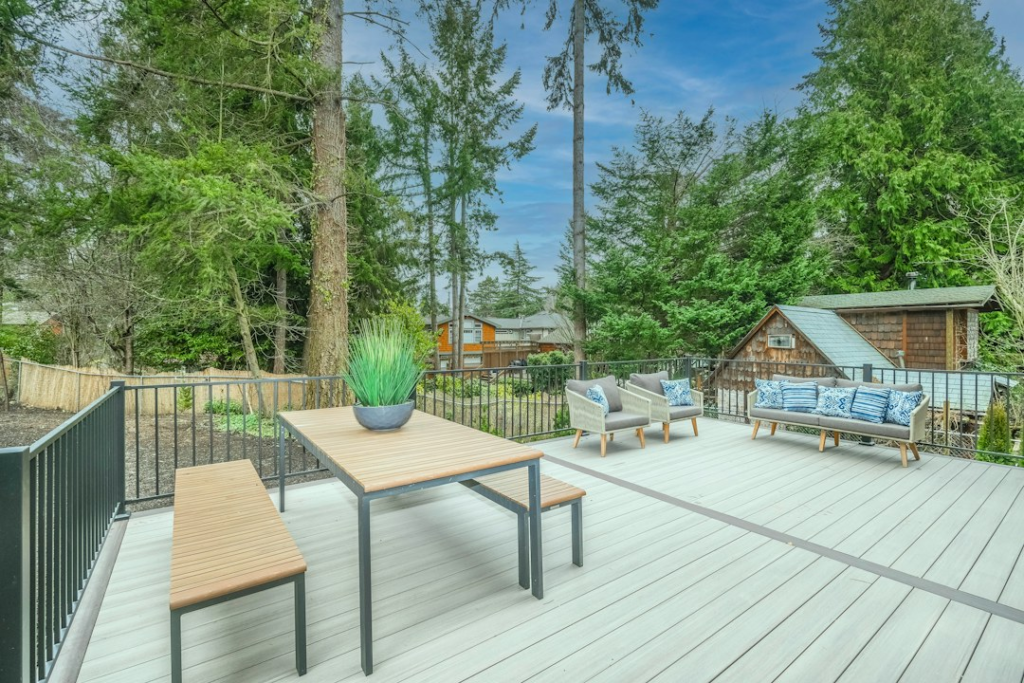
Trex decking costs about $45 to $70 per square foot for a professionally installed deck in 2026, including the substructure, decking and typical fasteners. The deck boards themselves commonly account for about $5 to $15 per square foot, while a complete project-material package is much higher because it also includes framing, hardware, fascia, stairs and waste.
That difference in scope explains why Trex prices can appear inconsistent online. A board-only retail price is not the cost of a finished deck. This guide separates product cost from the full installed project and covers the current Trex ranges: Enhance, Select, Transcend, Transcend Lineage and Signature. Trex Refuge is also noted as a specialist ignition-resistant PVC product rather than treated as an ordinary composite board.
In this Cost Guide
Trex Decking Cost at a Glance
| Cost item | 2026 planning range | What it includes |
|---|---|---|
| Deck boards only | $5–$15+ per sq. ft. | Trex deck boards before framing, hardware, labor and most trim |
| Typical project materials | $15–$30 per sq. ft. | Substructure, composite decking, hardware and fasteners; Trex excludes Signature from this published average |
| Complete installed deck | $45–$70 per sq. ft. | Typical framing, Trex decking, fasteners and professional installation |
| Premium or complex project | $70+ per sq. ft. | Signature or specialist boards, elevation, stairs, premium railing, lighting or difficult access |
These are national planning ranges, not a contractor quote. Local labor rates, permit requirements, ground conditions and the amount of railing can move a real project outside them.
Trex Deck Cost by Size
The following examples use the $45–$70 per-square-foot installed range. They assume a complete professionally built deck with a straightforward design. Demolition, extensive foundations, premium railing and electrical work can be additional.
| Deck size | Estimated installed cost | Typical use |
|---|---|---|
| 100 sq. ft. | $4,500–$7,000 | Small landing or compact seating deck |
| 144 sq. ft. (12×12) | $6,500–$10,000 | Dining table or small entertaining area |
| 200 sq. ft. | $9,000–$14,000 | Medium single-level deck |
| 300 sq. ft. | $13,500–$21,000 | Dining and lounge zones |
| 400 sq. ft. (20×20) | $18,000–$28,000 | Large outdoor living area |
Current Trex Decking Collections
Trex has expanded beyond the older Enhance, Select and Transcend hierarchy. The right comparison now includes board profile, appearance, warranty and intended application—not price alone.
| Collection | Position / warranty* | Key points |
|---|---|---|
| Trex Enhance | Value · 25 years | Scalloped composite board; practical entry point with Naturals and Basics-style color options |
| Trex Select | Mid-range · 35 years | Slimmer solid-profile board with a restrained color range; its thickness should be considered when mixing products |
| Trex Transcend | Premium · 50 years | Deeper wood-grain appearance and strong scratch resistance for high-visibility projects |
| Transcend Lineage | Premium · 50 years | Refined grain and heat-mitigating technology; the surface can still become hot in direct sun |
| Trex Signature | Luxury · 50 years | Most realistic appearance and Trex’s highest scratch-resistance positioning |
| Trex Refuge | Specialist PVC · 50 years | Ignition-resistant PVC option for applications where its tested fire performance is relevant |
*Warranty descriptions are summaries. Coverage, exclusions, transfer rules and registration requirements are controlled by the current Trex warranty documents.
Installed Cost by Main Composite Tier
National installed-cost data places Enhance projects near $45–$50 per square foot, Select near $55–$60, and Transcend near $65–$70 for typical work. Signature, Refuge, elaborate borders and unusual structures should be priced locally because they can exceed those bands. Collection is only one cost driver: a simple premium deck can cost less than an elevated value-line deck with extensive stairs and railing.
What Changes the Price of a Trex Deck?
Framing and Foundations
The visible boards are only one part of the build. Footings, posts, beams, joists, connectors and site preparation can consume a large share of the budget. A low deck on accessible, level ground is usually less expensive than a second-story deck or a site with poor access, slope or difficult soil.
Railing, Stairs and Fascia
Railing is priced by linear foot rather than deck area, so two decks with the same square footage can have very different totals. Stairs require additional framing, stringers, treads, railing and labor. Fascia, picture-frame borders and breaker boards improve the finish but add material and installation time. See the deck railing cost guide before treating railing as a small allowance.
Board Layout and Waste
A straight layout makes efficient use of 12-, 16- and 20-foot boards. Diagonal boards, herringbone details, curved edges and multi-color borders create more cuts and waste. Contractors may add roughly 10% for a straightforward layout and more for complex patterns, but the actual takeoff should be based on the plan.
Labor, Permits and Access
Labor varies by metro area and contractor demand. Permit, plan-review and inspection fees are local. Limited access can mean carrying material through a house, working around landscaping or using smaller equipment—all of which increases time.
Removal and Repairs
Resurfacing an existing deck is only appropriate when the frame is structurally sound and compatible with the new boards. Rot, corrosion, poor ledger attachment or inadequate joist spacing can turn a resurfacing job into a partial or complete rebuild.
Trex Versus TimberTech and Wood
Trex and TimberTech composite decking both span value through premium categories. A fair comparison uses similar tiers, profiles, warranties and local availability. TimberTech also sells Advanced PVC decking formerly known as AZEK, which is a different material and commonly carries a higher installed price.
Pressure-treated wood generally costs less at installation but requires periodic cleaning and refinishing. Trex costs more upfront, does not need routine staining or sealing, and avoids splinters associated with weathered wood. It is not maintenance-free: pollen, dirt, food, grease, leaves and mildew on surface debris still need prompt cleaning.
Installation Details That Matter
- Follow the current installation guide. Joist spacing, stair-tread support, gapping and fastener rules vary by product and application.
- Plan drainage and ventilation. Water should not remain trapped against the substructure or building.
- Use compatible fasteners. Hidden fasteners create an uncluttered field, while square-edge boards are commonly used at borders and stairs.
- Check board thickness. Trex notes that Select is thinner than several other ranges; careless transitions can create an uneven walking surface.
- Protect the structure. Joist and beam flashing can help keep water away from the top of wood framing when installed correctly.
Composite boards expand and contract with temperature. The manufacturer’s current fastening and gapping tables—not a generic rule—should govern the installation.
Care, Heat and Everyday Use
Use Trex’s current care instructions for the specific spill or stain. Routine cleaning normally begins with loose-debris removal and soap-and-water methods. Test any cleaner in an inconspicuous area and avoid unapproved solvents or improvised coatings.
All decking surfaces can become hot in strong sun. Color, air temperature, exposure and airflow matter. Lineage is marketed with heat-mitigating technology, but this does not make it cool in every condition. Samples should be viewed outdoors where the deck will actually be used. Similarly, slip resistance changes with water, ice, algae, pollen and surface contamination; good drainage and cleaning remain important.
Is Trex Worth the Cost?
Trex is strongest for homeowners who value low routine maintenance, consistent appearance, broad contractor familiarity and a long manufacturer warranty. It is less compelling when the lowest initial cost is the main goal or when the owner prefers the repairability and natural aging of real wood.
The best value is often not the cheapest board. Compare a complete specification: collection, color, board profile, fastener system, framing, railing, stairs, fascia, permits, removal and warranty responsibilities. A vague “Trex deck” quote does not contain enough information to compare bids.
Questions to Ask Before Accepting a Quote
- Which exact Trex collection, color and board profile is included?
- Is the quote for resurfacing or a complete new frame and deck?
- What footing, joist and ledger work is included?
- How much railing, stair and fascia work is allowed for?
- Are permits, demolition, disposal and site restoration included?
- What workmanship warranty does the contractor provide?
- Who registers the product warranty and supplies the final documentation?
For a useful starting point, estimate the footprint with the deck cost estimator, then request itemized local bids using the same scope.
Trex Decking Cost FAQs
How much does a 12×12 Trex deck cost?
A 144-square-foot Trex deck typically plans at about $6,500 to $10,000 installed using the national $45–$70 range. Stairs, railing, demolition and elevated framing can raise the total.
How much does a 20×20 Trex deck cost?
A straightforward 400-square-foot project plans at roughly $18,000 to $28,000 installed. Premium collections and complex structures can exceed this range.
Does Trex need to be stained?
No. Trex composite decking is not maintained like wood and should not be routinely stained or sealed. Clean it according to the current manufacturer guidance.
How long is the Trex warranty?
Current residential coverage varies by collection: Enhance is positioned with 25-year coverage, Select with 35-year coverage, and Transcend, Lineage, Signature and Refuge with 50-year coverage. Always read the warranty applying to the exact product purchased.
Can Trex be installed over an old frame?
Sometimes, but only after the frame, footings, ledger, connectors and joist spacing are inspected. A new surface should not conceal an unsafe or incompatible structure.
Sources and Cost Methodology
Reviewed September 2026. Deck Cost Guide uses current manufacturer product and warranty information to define what is being priced, then compares published national installed-cost data with project-size calculations. The figures above are an editorial planning range, not a copied contractor price list or a substitute for local bids. Read more about how we research deck costs.